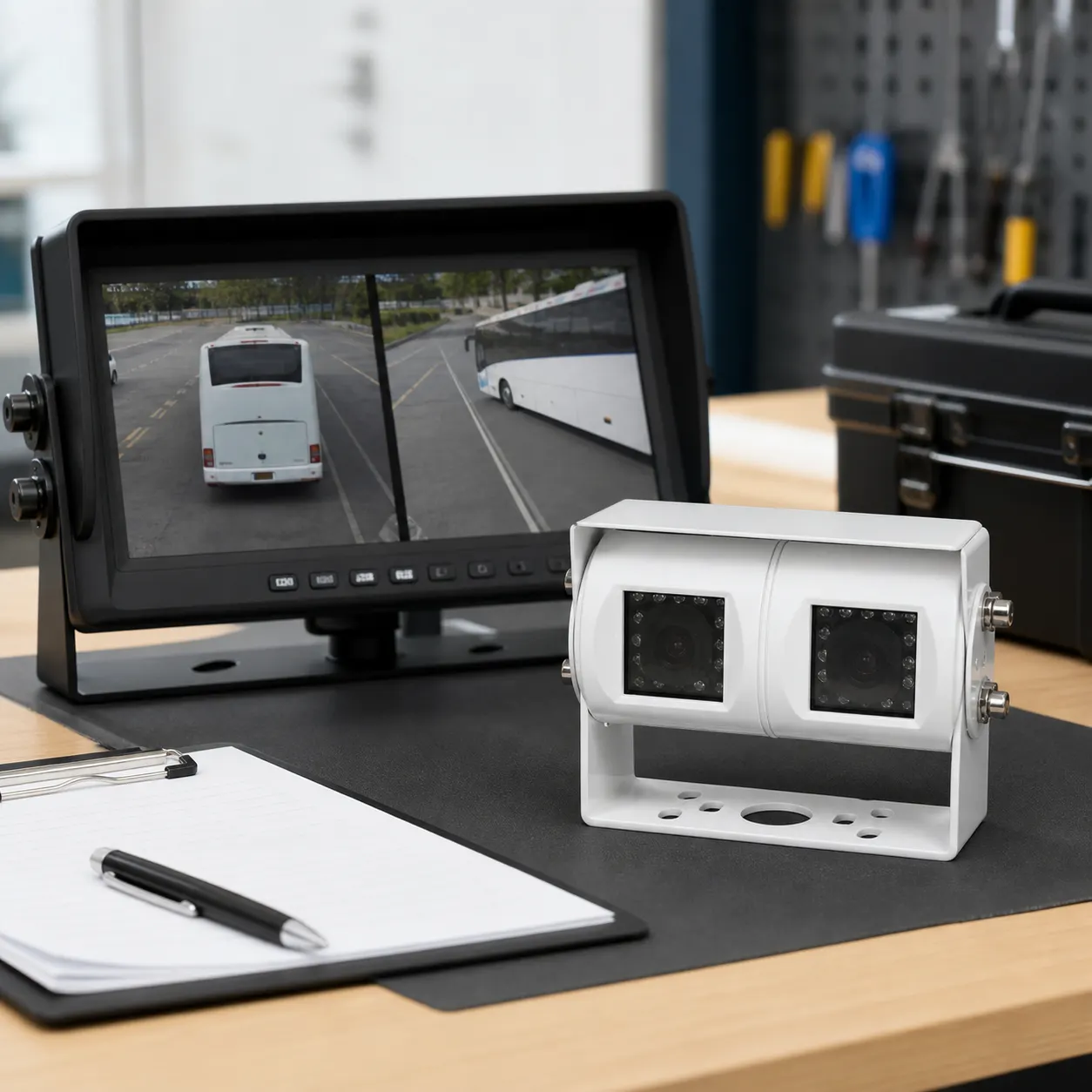
Short answer: For a truck reversing camera in the UK, begin with the exact vehicle and the place where the manoeuvre happens. The Dolphinaut PZ470-2 is documented as a white dual-head vehicle AV camera with AV video signal, 24V power voltage and 720 x 504 resolution. Those facts can start an installer conversation. They do not prove that a monitor, loom, trigger, mounting kit, waterproof rating, night vision, certification or full safety package is included. The camera should support a documented plan for the vehicle; it should never be used to make an unknown installation or unsafe reversing routine sound complete.
What a UK pre-fit review should answer
A pre-fit review should leave the workshop with fewer unknowns than it started with. Identify the truck, the rear bodywork, the intended viewing area, the cab display, the available power and the people responsible for installation and sign-off. The phrase UK truck reversing camera does not answer those questions by itself.
The review should also separate three decisions: whether the component can connect, whether it can be mounted for the intended view, and whether the finished arrangement belongs inside the fleet's safety procedure. Those decisions may involve different people. A product page can inform the first two, but it does not replace the operator's risk assessment or installer approval.
| Review area | Question to answer | Do not assume |
|---|---|---|
| Signal | Can the planned screen accept AV video? | That every cab display accepts every camera |
| Power | Does the 24V arrangement match the vehicle and wiring plan? | That a listed voltage proves final compatibility |
| Mounting | Will the camera sit where the installer and driver expect? | That the dual-head form fits every rear body |
| Safety | What procedure controls the manoeuvre? | That a screen replaces observation or a guide |
Keep the PZ470-2 evidence narrow
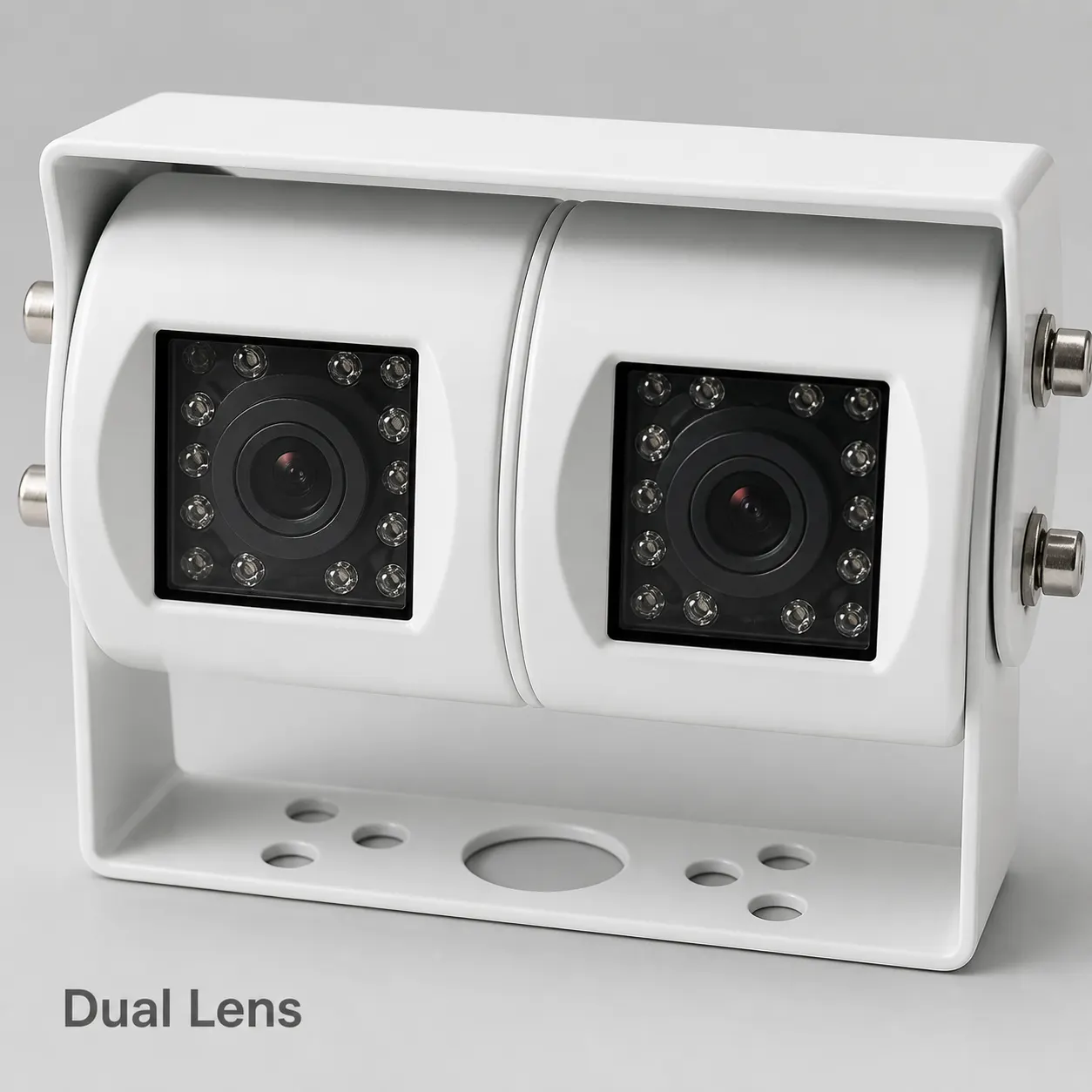
The current listing confirms the product name, white dual-head description, PZ470-2 model, AV video signal, 24V power voltage and 720 x 504 resolution. Those facts are suitable for a pre-fit worksheet. They allow the installer to compare the component with the vehicle's signal, supply and viewing plan without pretending that the listing is a full technical drawing.
The manufacturer does not specify waterproof performance, night vision, certification, cable length, monitor inclusion, recording, sensors, alarm functions, mounting hardware or final vehicle compatibility. If a procurement form asks for one of those values, leave it marked as unknown until written evidence arrives. A missing specification is not permission to borrow a number from another camera.
- Write PZ470-2 and the listed AV, 24V and 720 x 504 facts into the worksheet.
- Add the exact truck, monitor input, power source and mounting location.
- Record every required feature that the product page does not specify.
- Ask the installer to confirm the complete route before scheduling vehicle downtime.
Set the driver and site boundary
The Highway Code says to choose an appropriate place, check carefully before reversing, use mirrors, check the blind spot and look for people, cyclists, other road users and obstructions. It says to reverse slowly while checking all around and to get someone to guide the manoeuvre where the driver cannot see clearly. These are the operating boundaries for the road, not optional extras created by the product.
HSE workplace transport guidance adds site-level controls: plan how vehicles and people move, separate routes where possible, provide adequate lighting, avoid reversing where possible and use appropriate reversing aids such as CCTV. A truck camera may support that plan, but the camera's presence does not prove that the plan is adequate or that the final installation meets a particular scheme.
- Set the vehicle in a place where the installer can inspect the rear and cab together.
- Confirm the driver can use the display without losing the required outside observation.
- Test the approved manoeuvre and assistance procedure according to site rules.
- Stop and escalate when the view is unclear, the equipment fails or pedestrians enter the area.
Decide between component and package
A component-led purchase can make sense when the truck already has a known AV display, a compatible 24V arrangement, a workable cable route and an installer who can confirm the mount. It keeps the decision focused on one part. The trade-off is that the buyer carries more responsibility for checking the rest of the system.
A fuller package is the better comparison when the brief includes a supplied monitor, multiple views, recording, sensors, alarms, specific cable lengths, certification, customer paperwork or scheme requirements. The PZ470-2 page does not make those promises. Where they matter, choose evidence first and let the installer or responsible fleet lead sign off the complete arrangement.
Related guides and product details
A UK truck reversing camera purchase is ready only when the vehicle, display, 24V plan, mount, contents and safety procedure are all understood. The PZ470-2 can enter that review as a documented component, not as a universal or self-certifying solution. Read Commercial Vehicle Reversing Camera Checks for UK Fleets for related guidance. Read Rear-View Camera for a Truck: Checks Before Ordering for related guidance. Review the documented specification on the White Dual-Head Vehicle AV Camera, PZ470-2 product page before ordering.
Sources and safety context
- Supports the PZ470-2 identity and the listed AV, 24V and 720 x 504 product facts. Current Dolphinaut product page.
- Supports the workplace safety boundary around vehicle movements, pedestrians, lighting, avoiding reversing and CCTV aids. HSE: Introduction to workplace transport safety.
- Supports the road reversing checks, slow manoeuvring and use of a guide when visibility is unclear. GOV.UK: The Highway Code, rules 200 to 203.