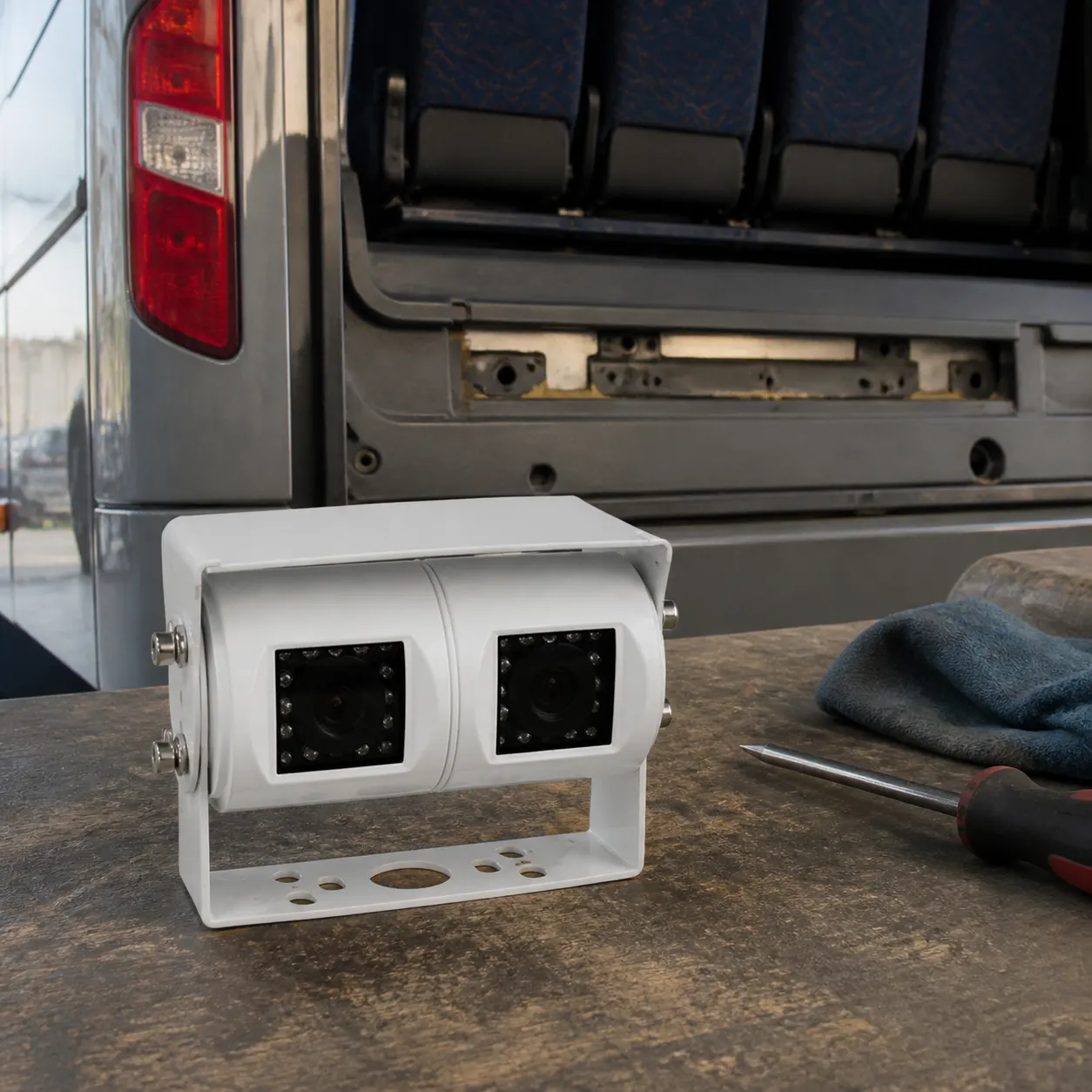
Short answer: A commercial vehicle reversing camera should be assessed as one part of a vehicle and workplace safety arrangement, not as an automatic substitute for mirrors, observation, a trained driver or a site plan. The Dolphinaut product page lists the PZ470-2 as a white dual-head vehicle AV camera with 24V power voltage and 720 x 504 resolution. Those facts support a compatibility conversation with an installer. They do not confirm a complete monitor kit, waterproof rating, night vision, certification, recording, sensors or final compliance suitability. Match the component to the actual vehicle before ordering.
Define the reversing job first
A fleet buyer should begin with the manoeuvre rather than the camera headline. Is the vehicle reversing in a depot, loading bay, workshop or controlled yard? Who will fit the equipment? Does the vehicle already have a display and cable route? The answer determines whether you are replacing a component or planning a wider system.
HSE workplace transport guidance says to avoid reversing where possible and identifies reversing aids such as CCTV as appropriate controls within a wider approach. That does not make any camera a safety guarantee. The camera must be considered alongside pedestrian separation, lighting, site layout, supervision, driver training and the specific risks of the manoeuvre.
| Check before purchase | Why it matters | What this product page confirms |
|---|---|---|
| Vehicle and task | The body, yard and manoeuvre set the installation need | No vehicle class or final fitment is confirmed |
| Display input | The cab screen must accept the camera signal | AV video signal is listed |
| Power arrangement | The installer must match the vehicle wiring safely | 24V power voltage is listed |
| Safety sign-off | The finished system needs site and driver controls | No compliance package is stated |
Match the documented component to the cab
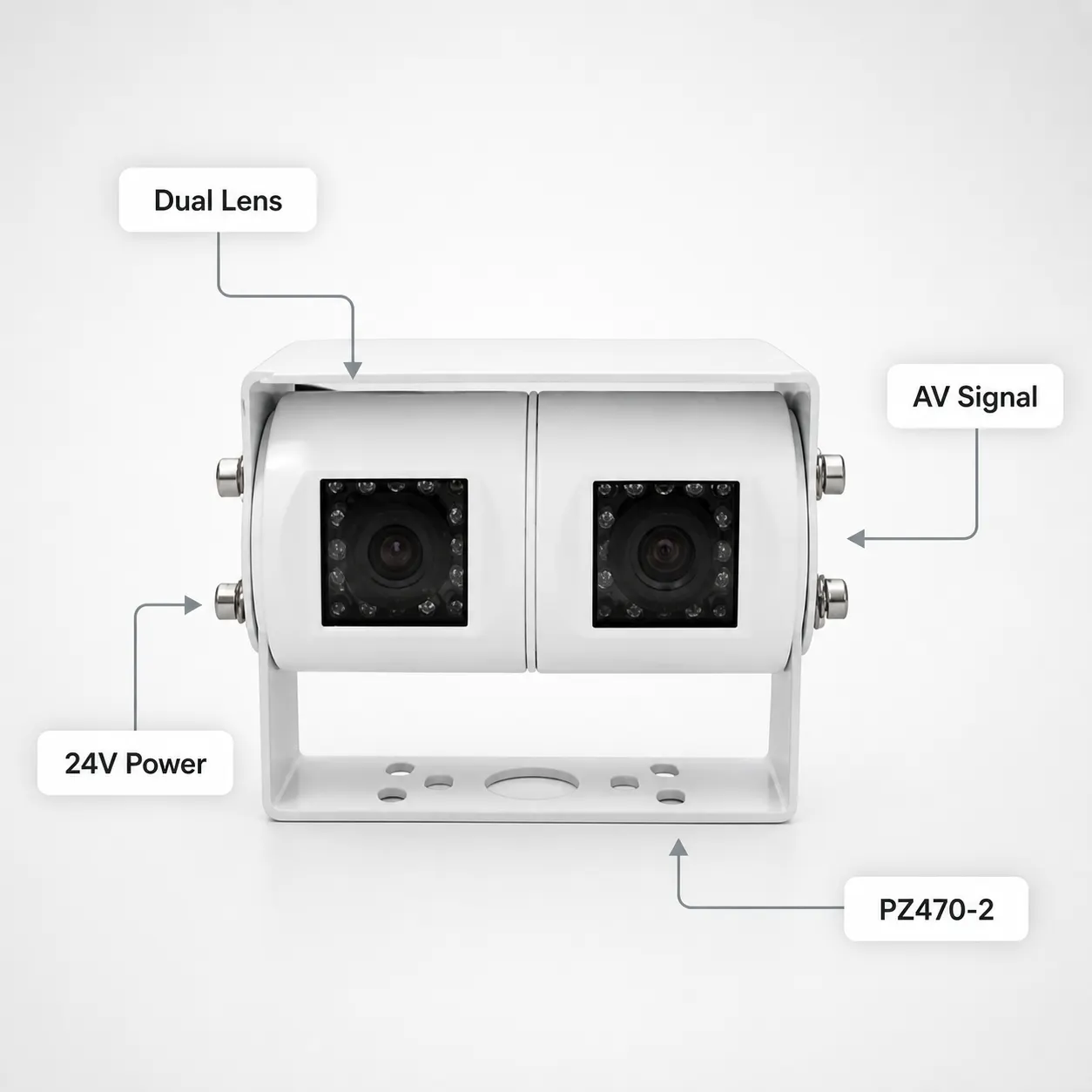
The current product page identifies a white dual-head vehicle camera, model PZ470-2, with AV video signal, 24V power voltage and 720 x 504 resolution. Those are the facts a vehicle electrician or workshop lead can place beside the existing monitor, supply and mounting plan. They do not establish that any particular truck, bus, van, head unit or loom will accept the component.
The manufacturer does not specify waterproof performance, night vision, certification, cable length, monitor inclusion, recording, sensors, alarm functions, mounting hardware or final vehicle compatibility. Do not infer those details from the product name, photographs or a similar camera. If one is mandatory for your fleet record, obtain written evidence before approving the part.
- Record the vehicle type, electrical supply and existing camera or monitor arrangement.
- Confirm that the planned display accepts an AV video signal.
- Ask the installer to check the 24V supply, ground, trigger and cable route.
- Confirm what is included and what must be sourced separately.
- Document any required waterproof, low-light, certification or compliance evidence.
Keep the safety boundary visible
The Highway Code says drivers should use mirrors, check the blind spot and check for pedestrians, cyclists, other road users and obstructions before reversing. It also says to reverse slowly while checking all around and to get someone to guide the manoeuvre if visibility is not clear. A camera view can contribute information, but it cannot remove those responsibilities.
For workplace movements, HSE recommends planning vehicle and pedestrian routes, avoiding reversing where possible and using suitable controls such as reversing aids where appropriate. The final arrangement belongs to the fleet operator and site risk assessment. Do not describe the PZ470-2 as a certified safety system, legal compliance solution or replacement for a trained banksman unless separate evidence supports that claim.
- Keep the camera within the driver's wider observation and site procedure.
- Do not rely on a screen when the view is dirty, blocked, misaligned or unavailable.
- Stop the manoeuvre when the driver cannot see the required area clearly.
- Use a trained guide or another control where the site risk assessment requires it.
When a fuller system is the better fit
A camera component may suit a workshop that already has a compatible display, a known 24V installation and a defined mounting route. It is a different purchase from a complete camera-monitor package, multi-camera system, recorder, sensor and alarm arrangement or installer-led compliance project.
Choose a fuller documented system when the job depends on supplied cab hardware, specified cable lengths, recording, multiple views, formal certification, customer paperwork or a named fleet scheme. The PZ470-2 may still be considered as a component if the installer confirms the fit, but its product page does not carry those wider promises.
Related guides and product details
Use the PZ470-2 as a component to verify with the vehicle electrician and site safety lead. Buy only when signal, power, mounting, contents and the wider reversing procedure are clear; otherwise choose a better-documented system. Read Rear-View Camera for a Truck: Checks Before Ordering for related guidance. Read Truck Reversing Camera UK: A Pre-Fit Compatibility Guide for related guidance. Review the documented specification on the White Dual-Head Vehicle AV Camera, PZ470-2 product page before ordering.
Sources and safety context
- Supports the PZ470-2 model, white dual-head description, AV signal, 24V power voltage and 720 x 504 resolution. Current Dolphinaut product page.
- Supports the wider workplace controls, avoiding reversing where possible and using reversing aids such as CCTV where appropriate. HSE: Introduction to workplace transport safety.
- Supports the boundary that drivers must check all around, use mirrors and reverse slowly, with help when visibility is unclear. GOV.UK: The Highway Code, rules 200 to 203.